
Blog
When to rebuild a shaft instead of replacing it
A worn journal is not automatically scrap. Often it is the faster and cheaper fix — sometimes it is not. Here is how we think about it.
The question behind the question
When a shaft comes off a machine with a worn journal, a scored seal surface or a spun bearing fit, the reflex is to price a replacement. Sometimes that is right. Often it is slower and more expensive than restoring the shaft you already have — and occasionally the replacement does not exist to buy at all.
The honest answer depends on the part. But the trade-offs are consistent, so you can usually tell which way a job leans before you ever send it out.
When rebuilding usually wins
If the shaft is fundamentally sound — no cracks, no bent geometry, base material in good condition — and only a surface or a diameter is worn, rebuilding is frequently the better call. Hard chrome plating restores a worn diameter from as little as .0001" up to .050", and it is then ground back to print. Thermal spray does the same where the duty calls for a different material. Either way you keep the original forging, the original keyways, and the original everything-else.
Rebuilding tends to win hardest on long-lead or obsolete shafts. If the OEM quotes sixteen weeks, or no longer makes the part, restoring the one in your hand is not just cheaper — it is the only route that gets the machine running this month.
Rebuilding is usually the better call when
- The base material is sound — the wear is on the surface, not through the part
- The replacement is long-lead, expensive, or obsolete
- The shaft carries features that are costly to reproduce — keyways, splines, threads
- You need it back fast and the OEM cannot deliver
- Only a diameter or a seal surface is worn, within what plating or spray can restore
When replacement is the right answer
Rebuilding is not always right, and a shop that tells you it always is has stopped doing engineering. If the shaft is cracked, bent beyond straightening, or the base material itself has fatigued, restoring the surface just puts a good coating on a bad part. If the part is cheap, in stock, and easy to swap, the labour to rebuild it may not pay off.
The point is to make that call on the part in front of you, not on a rule of thumb. Send it — a drawing, a photo, the dimensions you can measure and how it failed — and we will tell you plainly which way it leans, including when the answer is 'buy a new one'.
Where the single roof changes the math
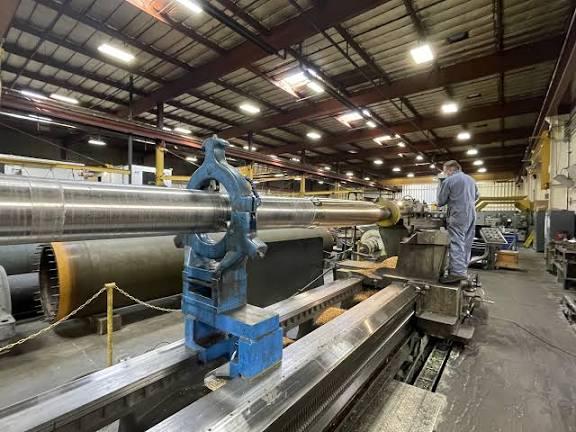
A rebuild is rarely one operation: the shaft is evaluated, built up, machined and ground back to size, then inspected. When those steps live in one building, the labour and the schedule are tighter than when a part crosses three vendors' docks — which is often what tips a borderline job toward rebuilding. At BBC, plating, spray, grinding, machining and inspection are all on the same floor.
Not sure which way your shaft leans?
Send it over. We will give you a straight answer — rebuild or replace.
Related
Services
Hard Chrome Plating
Hard chrome plating from .0001" for corrosion protection to .050" for rebuild, to AMS 2460 and AMS 2406.
Services
Precision Grinding
Cylindrical and internal ID grinding — the finishing step that brings plated and sprayed components back to print.
Resources
Specifying a Repair
What to send us so the quote comes back fast and right the first time.
Send us the part
A drawing, a photograph, or just a description of how it failed. We will tell you what we would do with it.